


Commercial building owners and facility managers face ongoing challenges in preserving physical infrastructure while managing long-term capital outlays. A commercial roofing assembly represents one of the largest physical investments in any property, constantly exposed to harsh environmental factors such as severe ultraviolet radiation, intense temperature swings, ponding water, and airborne industrial pollutants. Over time, these stressors cause waterproofing membranes to age, dry out, crack, and lose elasticity, leading to persistent leaks and premature structural decay.
Instead of incurring the massive expense, operational disruption, and environmental waste associated with a complete roof tear-off and replacement, modern facility directors increasingly turn to fluid-applied restoration systems. Professional elastomeric and silicone roof coatings offer a cost-effective, sustainable solution that extends system service life, improves thermal efficiency, and restores complete watertight integrity to existing roof decks.
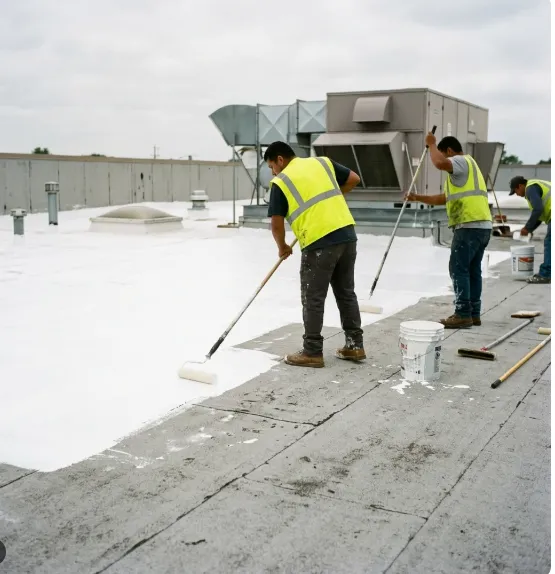
The Chemistry and Science of Fluid-Applied Restoration
Commercial roof coatings are not standard exterior paints. They are highly engineered, elastomeric fluid membranes formulated to bond seamlessly with existing roofing substrates, creating a monolithic, joint-free protective barrier across the entire roof plane.
Unlike traditional pre-fabricated roll membranes that rely on glued or heat-welded seams, fluid-applied systems cure into a continuous rubberized layer that encapsulates flashings, mechanical curbs, plumbing penetrations, and perimeter transitions. This seamless integration eliminates the primary failure points common to aging commercial roofs.
|
Coating Chemistries |
Key Chemical Properties |
Primary Strengths |
Ideal Substrate Applications |
|
Silicone Coatings |
High solids, inorganic silicone polymer matrix |
Permanent ponding water resistance, high UV stability, zero chalking |
Flat roofs, low-slope roofs, aged EPDM, smooth BUR, and modified bitumen |
|
Acrylic Coatings |
Water-based elastomeric polymers |
Excellent tensile strength, high reflectivity, cost-effective application |
Metal roofs, concrete decks, sloped commercial roofs, and weathered TPO |
|
Polyurethane Coatings |
Aromatic or aliphatic resin compounds |
High impact resistance, extreme durability against heavy foot traffic |
Roofs hosting heavy mechanical gear, high-traffic access areas, and gutters |
|
Asphalt Emulsion |
Clay-stabilized asphaltic base layer |
Excellent bulk restoration layer for heavily oxidized asphalt roofs |
Built-Up Roofing (BUR) and modified bitumen baseline leveling |
Operational Advantages of Roof Coating Systems
Implementing a fluid-applied restoration system provides distinct operational, financial, and environmental benefits compared to full tear-off replacements.
Capital Expenditure and Tax Benefits
A complete roof replacement requires extensive labor, structural teardown, landfill disposal fees, and new material installation, making it a major capital expenditure. Fluid-applied coating applications are typically classified as maintenance operations under accounting standards. This classification allows property owners to expense the investment in the year incurred rather than amortizing the cost over multi-decade depreciation schedules.
Minimal Operational Disruption
Tearing off an existing roof exposes interior spaces to weather risks, noise, structural dust, and physical safety hazards. For active enterprise facilities, logistics centers, hospitals, and commercial office complexes, operational downtime carries severe financial consequences. Applying a professional coating system generates minimal noise, requires no heavy demolition equipment, and allows business activities inside the facility to continue without interruption.
Sustainability and Environmental Stewardship
Roof tear-offs contribute millions of tons of construction waste to municipal landfills annually. Fluid-applied restoration systems allow building owners to keep existing insulation and structural membranes in place, transforming a worn roof deck into a high-performance barrier while significantly reducing carbon footprints.
Key Substrates and Surface Preparation Requirements
A fluid-applied system derives its longevity directly from proper surface preparation and adhesion testing. Applying high-performance coatings over dirty, wet, or structurally compromised substrates guarantees premature adhesion failure.
Prep Work on Single-Ply Membranes (TPO and EPDM)
Aged single-ply membranes often accumulate oily film residues or surface oxidation. High-pressure washing combined with specialized substrate cleaners is required to ensure proper surface profile adhesion. All loose seams, flashing details, and field splits must be reinforced with mesh fabric embedded in heavy-bodied sealant before applying the top coat.
Prep Work on Metal Roof Assemblies
Metal roofs experience substantial thermal expansion and contraction, which can loosen fasteners and open lap joints over time. Surface preparation involves tightening or replacing loose screws, treating rust spots with specialized rust-inhibitive primers, and encapsulating every panel lap seam with elastomeric mastic.
Facilities managers seeking to evaluate substrate compatibility, perform thermal moisture audits, or design customized restoration plans can explore options for commercial roof coatings to establish long-term maintenance protection tailored to their building envelope.
Thermal Performance and Energy Savings
Dark, unreflective roof surfaces absorb vast amounts of solar radiation, reaching surface temperatures up to 180 degrees Fahrenheit during summer months. This thermal energy transfers directly into the building, forcing mechanical cooling systems to work harder and consuming substantial electricity.
High-reflectivity cool roof coatings feature high solar reflectance (SR) and thermal emittance (TE) ratings. White silicone and acrylic coatings reflect over eighty percent of incoming solar radiation away from the structure and rapidly re-emit absorbed heat.
-
Lower Interior Cooling Loads: Reducing rooftop surface temperatures from 180 degrees down to near-ambient levels dramatically decreases cooling demands on upper-floor commercial spaces.
-
Extended HVAC Lifespan: Lower peak cooling requirements reduce operating cycles on rooftop chillers and air handling units, extending mechanical equipment lifespan and reducing maintenance costs.
-
Mitigation of Urban Heat Islands: Widespread adoption of reflective fluid membranes helps lower ambient outdoor temperatures in dense urban environments.
Maintenance and Renewal Cycles for Maximum Service Life
Fluid-applied roof coatings offer a unique renewable lifecycle. When a ten- or fifteen-year coating warranty reaches maturity, the underlying membrane system remains fully protected. Provided the roof is kept clean and intact, a qualified applicator can inspect the surface, perform localized seam maintenance, and apply a fresh top coat to extend system service life for another decade or more.
To achieve maximum longevity from a fluid-applied system, facility managers should maintain a bi-annual inspection routine:
-
Clear Drainage Outlets: Remove leaves, sediment, and airborne debris from roof drains, scuppers, and gutters to prevent standing water accumulation.
-
Inspect Walkway Pads: Ensure service technicians use designated walkway pads when accessing HVAC machinery to prevent physical punctures.
-
Audit Flashings and Curbs: Check metal transitions and equipment curb details twice a year for physical movement or mechanical damage.
-
Schedule Post-Storm Reviews: Inspect roof surfaces following severe windstorms or hail events to identify and repair localized impact damage quickly.
By leveraging modern fluid-applied technology, commercial property owners can restore aged roof assemblies, cut energy costs, and extend building envelope longevity while maintaining predictable, sustainable maintenance budgets.