


Investing in a custom residential swimming pool alters the physical footprint and functional appeal of a property. For homeowners evaluating large-scale exterior improvements, understanding the financial and lifestyle returns on investment (ROI) is essential. While traditional home renovations such as kitchen updates or roof replacements are measured primarily by immediate monetary equity gains, swimming pools offer a unique combination of financial value, regional market desirability, and ongoing lifestyle quality. Evaluating a pool’s return requires analyzing localized real estate trends, structural longevity, low-maintenance technology, and exterior outdoor integration. By examining both quantitative financial metrics and qualitative personal benefits, property owners can determine how a custom aquatic installation contributes to long-term property equity and daily domestic life.
Financial Equity vs. Lifestyle Return on Investment
Calculating the true return on investment for a custom pool requires looking beyond short-term resale estimates. Real estate professionals divide pool ROI into two distinct categories: direct financial equity and subjective lifestyle equity.
Direct financial equity refers to the incremental market value added to an appraisal when a home is listed for sale. In warm, sunny regions where outdoor living is a year-round norm, a well-built in-ground pool can significantly increase buyer interest and boost overall property valuation. Conversely, in colder climates with short summer seasons, financial ROI may be lower due to higher winterization demands and shorter annual usability windows.
Lifestyle equity represents the unquantifiable personal value derived from owning a private aquatic retreat. This includes savings on public club memberships, reduced vacation travel expenses, dedicated health and fitness opportunities, and a private venue for family entertainment. When factoring in years of personal recreation, the cumulative value of a custom pool often extends far beyond its initial construction costs.
Key Factors That Influence Pool Appraisal Value
Not all residential pools yield the same return. Appraisers and real estate buyers evaluate several core elements when determining how much value an in-ground pool adds to a home:
-
Neighborhood Standards and Comparables: If nearby homes in a subdivision frequently feature in-ground pools, lacking one can place a property at a competitive disadvantage during resale. In high-end neighborhoods, a pool is often considered an expected standard feature rather than an optional luxury.
-
Quality of Materials and Construction: Monolithic concrete (gunite) basins finished with premium travertine coping and high-grade plaster retain value much better than basic vinyl-liner alternatives. Durable construction materials resist wear, maintaining their visual appeal for decades.
-
Surrounding Landscape Integration: A pool that sits awkwardly in a yard without supporting hardscape yields a lower return than an integrated backyard layout. Cohesive patio decking, retaining walls, shade structures, and functional outdoor kitchens create an expanded living environment that maximizes appraisal returns.
-
Proportional Yard Balance: A pool should complement the property without completely eliminating green lawn space. Overbuilding a massive pool basin on a small lot can deter future buyers who still desire grass areas for pets or gardening.
Financial Profile Across Pool Types and Features
The long-term financial performance of a pool installation is heavily influenced by the initial construction method and integrated equipment choices.
|
Property Component |
Upfront Cost Level |
Long-Term Equity Contribution |
Key Maintenance & Utility Factors |
|
Custom In-Ground Concrete Pool |
Higher initial investment |
High long-term resale value |
Extremely durable; requires replastering every 10–15 years. |
|
Variable-Speed Automation Pumps |
Moderate initial cost |
Positive buyer asset appeal |
Cuts energy usage up to 80 percent compared to single-speed pumps. |
|
Saltwater Chlorine Generators |
Moderate initial cost |
Neutral to high asset appeal |
Reduces ongoing chemical costs and provides softer water feel. |
|
Integrated Hardscape & Decking |
Variable by material |
High long-term equity contribution |
Travertine and concrete pavers require minimal upkeep and offer strong durability. |
|
Energy-Efficient Heat Pumps |
Moderate to high cost |
Positive buyer asset appeal |
Extends swimming season while keeping monthly heating expenses manageable. |
Maximizing Value Through Modern Construction Practices
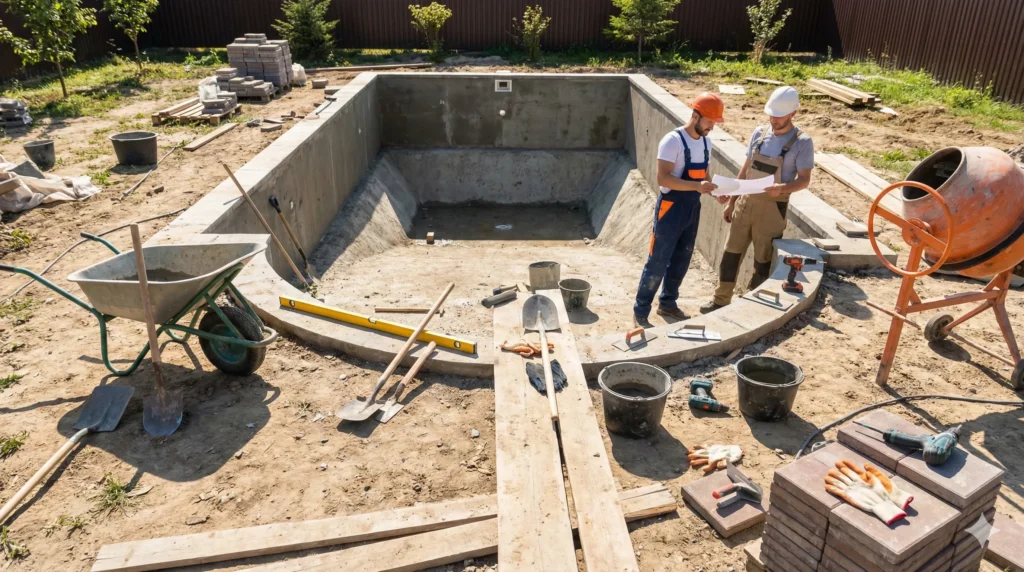
To achieve the best return on investment, homeowners must focus on structural durability and energy efficiency during the initial construction phase. Cutting corners during site excavation, soil compaction, or steel rebar framing leads to costly structural repairs down the road, quickly eroding potential equity gains.
Working with experienced professionals during the architectural phase ensures that soil stability, drainage slope, and utility access are engineered to high standards. Homeowners embarking on new pool construction often pair custom concrete basins with energy-efficient variable-speed pumps, automated salt chlorination systems, and low-voltage LED lighting to minimize monthly operational expenses while building a long-lasting property asset.
Lowering Operational Costs to Protect Long-Term ROI
A common concern among property owners is the ongoing cost of electricity, water, and pool chemicals. Modern pool technology has significantly reduced monthly operational demands, transforming pool ownership from a high-maintenance burden into an efficient home asset.
-
Variable-Speed Pumps: Unlike older single-speed pumps that run at maximum wattage continuously, variable-speed units adjust flow rates according to filtration needs, dramatically lowering monthly electric bills.
-
Automated Water Chemistry Controllers: Smart monitoring systems test water balance continuously and feed precise sanitizer doses, preventing chemical waste and protecting interior plaster from scale or etching.
-
Thermal Pool Covers: Using a fitted solar or thermal cover reduces water evaporation by up to 90 percent and preserves thermal energy overnight, minimizing gas or heat pump heating demands.
Strategic Outdoor Upgrades That Boost Resale Appeal
To maximize the financial return of a pool project, surrounding exterior features should be planned as part of a unified master design. Buyers view an outdoor living area holistically, evaluating how smoothly the home’s interior transitions into the backyard environment.
Extending travertine or interlocking concrete paver decking from the pool coping toward an outdoor kitchen or seating area creates a multi-functional entertainment venue. Installing low-voltage LED landscape lighting along walkways and water feature perimeters highlights architectural details after dark, creating impressive curb appeal during evening home viewings. Adding built-in gas fire features or raised masonry retaining walls provides physical warmth and structural definition, ensuring the backyard remains functional across all four seasons.
Making an Informed Property Investment
Adding a custom swimming pool to a residential property offers a compelling combination of long-term equity potential and immediate lifestyle improvement. While financial returns depend on location, material quality, and neighborhood standards, the daily recreation, health benefits, and personal enjoyment provided by a private backyard retreat are unmatched by most interior upgrades. By prioritizing durable construction materials, energy-efficient operational equipment, and cohesive hardscape planning, property owners can build a high-value outdoor space that delivers reliable returns and lasting satisfaction for years to come.