


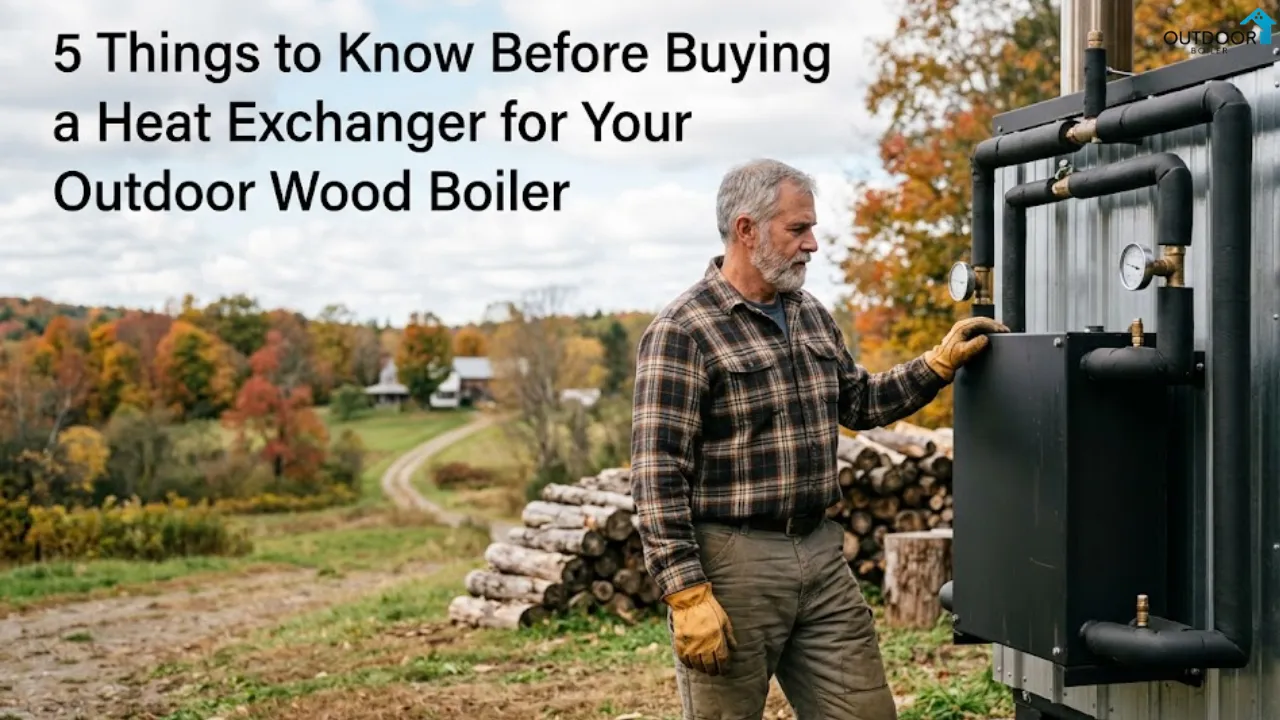
Buying a heat exchanger for your outdoor wood boiler is not complicated once you know what to look for. Here is what every homeowner should understand before spending a single dollar.
1. There Is More Than One Type of Heat Exchanger
This is the part that trips up most people. When you start shopping for a heat exchanger for your outdoor wood boiler, you will quickly realize there are three main types, and each one serves a different purpose.
Water-to-Air Heat Exchangers are the most common. They transfer heat from your boiler water into the air inside your home or building. Think of it like a car radiator but in reverse. Hot water runs through copper tubes with metal fins attached. A blower fan pushes air across those fins, and warm air fills the room. These are typically installed inside a forced-air duct system or furnace plenum.
Water-to-Water Plate Heat Exchangers transfer heat from one body of water to another without ever mixing the two. This is what you need if you want to heat your domestic hot water supply, an in-floor radiant heating system, or a baseboard radiator system using your boiler water.
Unit Heaters are the most straightforward option. They are self-contained boxes that include a built-in heat exchanger and blower fan. You hook them up to your boiler, set your thermostat, and the unit does the rest. They work best in garages, workshops, and barn spaces.
Knowing which type you need before you shop saves you a lot of time and money.
2. Size Matters More Than You Think
Picking the wrong size heat exchanger is one of the most common and costly mistakes homeowners make. Too small and your space never gets warm enough. Too large, and you are spending more than you need to.
Heat exchangers are rated in BTUs, which stands for British Thermal Units. This is simply a measurement of how much heat output the unit can deliver. A water-to-air heat exchanger for a small room might only need around 100,000 BTUs, while a large shop or multi-room system could require 200,000 BTUs or more.
To figure out the right size, you need to calculate the square footage of the space you are heating, factor in your ceiling height and insulation quality, and account for your local climate. A poorly insulated building in Minnesota needs significantly more heat output than the same-sized building in Virginia. Read the full article HERE.
If you are unsure, OutdoorBoiler.com has sizing guides and a technical support team that can walk you through the calculation without charge.
3. Your Existing System Affects Which Heat Exchanger You Can Use
A lot of people forget to think about compatibility. Your outdoor wood boiler does not operate in isolation. It connects to your home’s existing heating infrastructure, and that infrastructure determines which heat exchanger will actually work for you.
If your home already has a forced-air furnace, a water-to-air heat exchanger installed in the plenum above the furnace is usually the most practical choice. It takes advantage of the ductwork that is already there.
If your home uses baseboard radiators or radiant floor heating, you need a water-to-water plate heat exchanger to transfer heat between the boiler loop and your existing heating loop.
If you are heating a detached structure like a shop or barn with no existing ductwork, a unit heater is almost always the cleanest and simplest solution.
Understanding your current setup before you buy prevents the frustrating experience of ordering the wrong product and starting over.
4. Water Quality and Corrosion Protection Directly Impact Performance
This is something many first-time buyers overlook entirely. Water is the best heat transfer fluid in nature, which is why boiler systems rely on it. But water that is not properly treated will corrode the inside of a steel boiler and degrade the performance of your heat exchanger over time.
Corrosion buildup inside the system reduces flow, drops efficiency, and can eventually lead to leaks or complete failure of the heat exchanger. This is especially true for plate heat exchangers, where the narrow channels between plates are vulnerable to scaling and buildup.
The fix is straightforward. Use a quality corrosion inhibitor treatment in your boiler water and check the water chemistry on a regular schedule. It is a small ongoing cost that protects a much larger investment.
This applies whether you are installing a brand-new system or adding a heat exchanger to an existing outdoor boiler setup.
5. Installation Is Doable but Requires Attention to Detail
Many homeowners do install their own heat exchangers, and the process is manageable if you are comfortable with basic plumbing and following instructions. Most water-to-air heat exchangers, for example, simply rest on L-brackets inside the furnace plenum and connect to your boiler lines with standard fittings.
That said, there are a few things that make installation go sideways for people.
Getting the orientation wrong is a common one. Water-to-air heat exchangers usually need to be installed in a specific position to allow proper flow and drainage. Installing one at the wrong angle reduces efficiency and can cause problems over time.
Undersizing or oversizing the supply lines is another issue. If the pipe diameter feeding your heat exchanger does not match the flow requirements, you will not get the heat output the unit is rated for, even if everything else is done correctly.
Always read the installation instructions that come with the unit before you start. If anything is unclear, reach out before you begin rather than troubleshooting after the fact.
Frequently Asked Questions
Can I use a heat exchanger with any outdoor wood boiler brand?
Generally, yes, as long as the heat exchanger is appropriately sized for the BTU output of your boiler and the port sizes are compatible. Most residential outdoor wood boilers use 1-inch ports, but this can vary. Always verify port sizes before purchasing.
Do I need a heat exchanger if my outdoor boiler connects directly to baseboard radiators?
It depends on your setup. If your boiler water runs through a closed loop separate from your baseboard loop, then yes, you need a water-to-water plate heat exchanger. If your system was designed for direct connection, you may not. When in doubt, consult the documentation for your specific boiler model.
How long does a heat exchanger last?
A well-maintained heat exchanger in a properly treated system can last 20 years or more. Neglecting water treatment is the fastest way to shorten that lifespan significantly.
What happens if my heat exchanger is too small for my space?
Your boiler will run longer cycles trying to compensate, which increases wood consumption and wear on the system. You will also end up with a space that never quite reaches a comfortable temperature on the coldest days.
Is a unit heater better than a water-to-air heat exchanger?
Neither is objectively better. They serve different applications. A unit heater is ideal for open spaces without existing ductwork. A water-to-air heat exchanger works better when you want to integrate with an existing forced-air system.
Can one outdoor wood boiler run multiple heat exchangers?
Yes. Many homeowners run their outdoor boiler to multiple buildings and use a combination of heat exchanger types throughout the system. The key is making sure your boiler has sufficient BTU output to supply all zones and that your pump and piping are sized to handle the load.
Conclusion
Choosing the right heat exchanger for your outdoor wood boiler comes down to knowing your space, understanding your existing heating setup, and matching the right product to the right application. It is not an intimidating process once you break it down into these basics.
If you still have questions about sizing, compatibility, or installation, contact us; we’re always available to help. We know these systems inside and out and can point you in the right direction before you buy, not after something goes wrong.